16.3.13

A Strange Commonplace by Gilbert Sorrentino


Even before I learned that Gilbert Sorrentino was a critic's darling and the recipient of two (two!) Guggenheim Fellowships, I enjoyed and respected his work without always being able to explain why. Now that I know about his (two!) Guggenheim Fellowships, I can enjoy and respect his work without even bothering to read it. 

There is a slippery quality to some of his writing, by which I mean that I can simultaneously enjoy reading him while retaining very little. A Strange Commonplace is not slippery in that way, but it is blurry. Chapter titles are reused, and character's names are reused--either that or characters reappear in multiple forms. Almost any chapter could begin with almost any of the twenty-six chapter titles. It leaves the reader feeling as though they've spent a couple of hours sitting too close to the television, which is sort of (but not at all) what the epigraph promises:


                                            I passed through
     extraordinary places, as vivid as any
     I ever saw where the storm had broken
     the barrier and let through
     a strange commonplace: Long, deserted avenues
     with unrecognized names at the corners and
     drunken people with completely
     foreign manners.

     --William Carlos Williams


A Strange Commonplace is a vortex of cliches. Each of the novel's fifty-two chapters--populated with drunken people with completely foreign manners--tell very similar stories about ugly and deteriorating adulterous relationships. It's like switching between 100 channels of soap operas in that there is no sustained story but it matters little, as the plots are all predictable and identical.

If Sorrentino's project is to retell a cliche story in fifty-two not-very-different ways and yet still create a novel that is fresh and interesting, he's more or less succeeded. Sorrentino's passion for writing comes through even when he's writing about "somewhat fragmentary people--perhaps sketchy is a better descriptive" (108) in passionless affairs. He's taken a full shelf of novels about betrayal and disappointment, reduced them in a saucepan to a few pages, and used the reduction to flavor (with irony) the real meal, the joy of language.

While A Strange Commonplace is worth reading, if you haven't dined on Sorrentino before, start with Little Casino (and make sure to try his Mulligan Stew). A Strange Commonplace is full of reprehensible characters doing unkind things to each other, and first time readers may not be inclined to pick up his other works, which would be a shame.

Try as it might, this review cannot settle on a single metaphor. It cannot decide if Commonplace is a television show or a meal, but that's okay. It's likely equal parts image and flavor to savor.

Overall Chainsaw Rating:


10.12.12

The End of Faith by Sam Harris


Dividing people into groups for simplicity's sake is a dangerous practice. Phrases that begin with "There are two kinds of people in the world..." usually result in either a punch line or a punch thrown. However, Sam Harris's book The End of Faith is relevant to three different groups of people: those who believe in a god (or gods), those who do not, and those who aren't sure. That covers nearly everyone, except for maybe the Heaven's Gate cult, who believed in a cocktail of Star Trek and cyanide.

If you've already heard about this book--and you might have, as it spent thirty-three weeks on the New York Times Bestseller List and many weeks more Making People Angry--you may have already passed judgement, no matter to which of the above three groups you might belong. If this is the first you've heard, the title has probably already provoked a rejoinder of sorts. I urge you to suspend judgement for long enough to read the book--the entire book--because Harris will surprise you, especially toward the end.

Around the same time that The End of Faith was published, several other books on the topic of non-theism were released, books that some refer to as works of "New Atheism." Harris's book is different from other books in that grouping in a couple of ways.

Harris quotes Sayyid Qutb: "The Koran points to another contemptible characteristic of the Jews: their craven desire to live, no matter at what price and regardless of quality, honor, and dignity" (p. 123).  Harris calls this statement "a miracle of concision," a statement that is, in itself, a miracle of concision, as is Harris's entire book. It's as clear, honest, and well-argued as a book can be. While reading, I had the sensation that Harris had gathered the loose threads of my stray thoughts and handed them to me in a bunch. Not only that, but he tied balloons to the ends of those threads, so not only did I have a bunch of balloons where I'd had nothing, but buoyancy as well.

The second way in which The End of Faith stands apart from other books of the sort is that, while Harris does argue that reason and faith are adversaries, he's a proponent of spirituality. He writes at some length about meditation and Buddhism in a way that is neuro-scientific instead of new age-y, and what he has to say about consciousness may change yours.  If the thesis of this book seems too contrary to your own position, this--Chapter 7--may be the easiest starting place.

I don't want to do Harris the disservice of poorly reconstructing his argument, or of poking about the incredible structure of that argument with this blog's flimsy stick, but I hope you read the book. The subject may be a touchy one, but it's important to almost all of us, no matter which "kind of people" we are. Even if you think Mr. Harris has climbed aboard the hell-bound handbasket, there's no harm in reading an argument that challenges your own perspective. If he can't persuade you on at least a few points, he may push you to be more thorough in your own argument. If you're thinking about killing yourself next time a comet passes, perhaps Harris can shake your faith in that belief before you pour the cyanide syrup on your pancakes.

Overall Chainsaw Rating:


2.4.12

Some Explanation is Required


There was a time in my life when I was more OCD than I am now, and during that time I kept lists for practically everything. In fact, one summer I kept a list of everything I did each day, and at the summer's end I tallied those lists and combined them into a single master list of summer activities. Then I knew that I'd eaten ice cream twenty-seven times, jumped in the lake sixteen, watched fireworks once, etc. I came across this list a few years ago and had the good sense to perceive its meaninglessness--its utter dedication to form and disregard to content--and to throw it out. At the same time I threw out a list I wish I'd kept; a list of all the books I read from middle school through college. This list was more a memory aid, which I wish for more and more often as my memory gets worse and worse.

I said all of that to say that during many of those years in which the book list was kept, I read an average of eighty books per year. I would finish books like Atlas Shrugged and Infinite Jest in less than two weeks. Well, things have changed, and I spend a lot more time drinking beer now than I did when I was young, so sometimes a week passes without the turning of a single page. This has something to do with how the flow of this blog has slowed. However, I'd also like to blame some of that on this:


The pencil is included in this photograph a) for scale and b) because it's what I use to prop the pages open so I don't throw my back out holding them apart manually. 

This is Joseph McElroy's Women and Men, and I've been reading it since last I posted. I'd tell you where my bookmark is if it weren't so embarrassing. Let's just say I'm closing in the end of the first sixth.

In any case, as a kind of breather, I began this book this week:


I plan to say more about it later, but you're welcome to read some first impressions of it by clicking here.

Just so you know, Women and Men isn't bad or dull, it's just so heavy that my commute to the coffee shop is now forty minutes instead of ten, so I barely have time to read before I have to come slog back home. 

2.12.11

Turn the Upstage Cheek


I've hadn't heard of Joseph McElroy, but it turns out he's been around for a long time, and has been compared to Pynchon, DeLillo, Barth, and Barthleme for an equally long time, and for an English major to not have heard of him, I'm gathering, is basically unspeakable. What if you'd never heard of your own birthday? Yeah, this is like that. Disaster.

There are only a couple of books that I've almost started reading again right after having finished them, and this is one of those books. It's not my favorite book, and in fact there were times when I had to consciously persevere, but the book is smart enough and I insecure enough that I'm convinced I only retained about one third of the text. So basically the book is the cool crowd and I'm the uninvited nerd trying to find a space at it's crowded lunch table and feeling ridiculous. I can say for sure that at some point there was an actress in a house.

As you may have guessed from the cover, the catalyzing event in the novel is a slap. You might also guess that the narrator is a fly, or at least has fly-vision, but you'd be wrong. The picture of the slap is tiled repetitiously because the cover designer didn't want to finish his job, apparently.

Really, what I have to say about this book is that it often seems that McElroy has more letters in his alphabet than the rest of us. He combines sounds in a single sentence that have never before been combined, and I can't imagine how this is possible unless he's creating sounds. These complex sentences kind of leave one feeling, well, slapped, and the way they disorient the reader is compounded by the way that contiguous sentences don't always seem conceptually related. Conversations between characters are especially disconnected; I certainly have no idea what the characters are talking about, usually, and it's unclear if they understand each other or not. They might as well be throwing rocks at each other from opposite sides of the Grand Canyon.

I have no idea what it is, or if I like it, but I recommend it. If you like a good slap.

11.11.11

Scary Every Time

Our television is far too large for the room. If your smartphone were as needlessly titanic as our television, you would need a crane to hold it to your ear. This means that when we watched David Lynch's Inland Empire last week, all of the ridiculously close close-ups were all too uncomfortably close, as in let's-tally-the number-of-pores-on-Laura-Dern's-nose close. If you've seen Inland Empire, then you know that there are a couple of extra-scary close-ups, which, when Laura Dern's face is three feet away from you and roughly eight times the size of your own face, are just unacceptably scary.

Take, for instance, this scene (viewer beware!). It starts (starts!) with a scary clown, and it only gets scarier. Well, perhaps this is not scary for those of you who may be sitting at respectable distances from your televisions, but for those of us who must constantly clean the nose prints from our tv screens, this shot is debilitating.

I am watching this scene again on my tiny little computer screen, without even embiggening the movie window, and it is still scary. It's a formulaic if not cheap scare; Sue's approach turns into an unexpected lunge, which is accompanied by a starling audio track. David Lynch (or at least his hair) is saying "Boo!" It's a cheap scare, or should be, and yet it's not. This must be because of the expression on Laura Dern's face, which appears to have suffered some kind of Lynchian re-sculpting, as if Lynch got in there and situated a bunch of toothpicks behind her face somehow, or perhaps a bear trap.

And (and!) this isn't the scariest Dern face Inland Empire has to offer. If you don't know what I'm talking about, Google it sometime when you don't want to sleep for a few days.

In fact, when David Lynch asked Laura Dern to be in his movie, the conversation must have gone something like this:

"Hello, Laura, it's David. I have this idea for a movie, and it basically involves you looking worse than you thought possible in an uncountable number of ways for almost three entire hours. I think it will be a good career move for you. Also, my babysitter used to burn me with cigarettes. Happy Bastille Day!"

All of this is to say that I haven't been reading, because I've been too busy having nightmares. If you're concerned about no trees having been harmed in the making of this blog post, then you should know that during the scene mentioned above, I pretty much ran out of the tv room through the wall, so there are some studs to replace.

19.8.11

What I Haven't Been Reading

Here are some books I haven't been reading this week. In fact, these are books that I haven't opened in awhile. Some I started reading over a year ago. I used to be the kind of person who would pick up a book and force myself through to the final sentence no matter what. I finished books so boring that they put me to sleep not only at night, but at random times during the day when the books were miles away. I could be doing something exciting, like saran-wrapping a toilet seat, when I'd accidentally think about The Law of Similars and boom I'd be asleep on the bathroom floor. I finished books so poorly written that the mechanics of my own speech and writing would be completely demolished. After finishing Along Came a Spider I couldn't arrange a complex sentence for months, and .


I am no longer that kind of person. Often, I don't finish reading the synopsis on the back of the book. I'm thirty. I have little time to waste. So, unfortunately, sometimes even books that are pretty okay, I'm sure, don't get read. These are all pretty okay books, but I think I'm done with them.

Something Said was really pretty good, and I like what Sorrentino has to say about poetry (mostly William Carlos Williams' poetry). Finally, though, I could more or less shrug it off, despite being a fan of Sorrentino's fiction.


Tests of Time was perhaps a poorly chosen title, as I caught myself counting the pages in each essay and ask myself, Okay, how long will this one take? Too long. As I read the first 2/3 of this book, I could hear my body decaying. This sound distracted me terribly.

There are about seven pages of the The Brothers Karamazov that you should read. I didn't find any of them in the first two hundred. Ask someone else to point them out. Ask someone who's wearing fur and making exclamations such as "Deuce take it!" and "Ach!" and "I am in great fury!"

And finally, I'll admit to starting Freedom only because I felt like ripping something entirely mediocre to shreds. However, the book nearly euthanized me. It's basically a literary Rufie. I honestly have no memory of the sixteen hours following my reading attempt. This a video that shows where I'd like to keep my copy of this book. I snuck my copy onto the bookshelf of a friend, but he noticed immediately and now we are in litigation.

Obviously the title is a reference to the Mel Gibson Movie Braveheart, as is the bird with the half-blue face on the cover. So derivative.


5.8.11

That There's a Fancy Rope

Before I get to today's book review, here's a heads-up as to what I'm going to read next: 


So you can look forward to that happenin' book review. I know you all get out there on Saturday nights and go to your crazy Pragmatism house parties and kick it up pragmatically at your wild Pragmatism nightclubs. I'm pretty sure this forthcoming book review will draw the crowds. To Phillip, who kindly loaned me this book: I've had your book for less than ten hours and already there is bike grease on it. I'm sorry. 

What did I just finish reading today? This:


And why should you care? Well, I'm not sure you will. But after thinking about it, I've decided I maybe care. Here's why.

At first I wanted to compare this novel to meeting an old friend you haven't seen for a year. Let's say you plan to meet this friend at a restaurant, and when you arrive at the restaurant, the friend is already at the table, and you talk for a couple of hours, and when you get up you realize he's been in a wheelchair the entire time and hasn't mentioned one word about his now being confined to a wheelchair.

After finishing the book, I don't want to talk about it like that at all.

Some people have called the prose in this novel "clean" or "muscular." They might be wrong. Actually, I can't imagine how muscular prose might read. It would be hard and dense and watching itself flex in the mirror all the time. Rutkowski's prose isn't like that at all. In fact, much of the book reads like a manual that explains how to plug in your toaster. I don't mean that as an insult.

What surprised me most about the book was how all of a sudden, about two thirds of the way through, it becomes a novel about bondage. No, not bondage as we are used to seeing it in literature, where the slaves are in bondage or the women are in bondage or the foreigners are in bondage. Yes, I'm talking about bondage in the That's-What-She-Said way. As in: Quick! I'm feeling lusty! Let's find the nearest drug store and buy the first thing we see that will allow me to lash your ankles to the garage door, which I will then open and close with you attached while I wear a ski mask. Bondage.

The funny thing is that when I reached that part of the book, I started to think that the reason that the book had, to that point, been kind of plain, was that the narrator was going to become a serial killer, and "clean" and "muscular" prose would, in retrospect, be totally calm and creepy. That's not at all what happened.

What does happen is that eventually the narrator meets a woman who is into swinging from her ankles upside-down and rather enjoys the paddle. Then the book no longer mentions bondage. Whatever those two are up to, it becomes none of the reader's business, and the book continues on to other things. These characters are not vilified for being weirdos.

People who might enjoy this book: fans of simple language that is not excessively and affectedly delicate, flash-fiction enthusiasts, and readers who are hanging upside-down.

2.8.11

House of Leaves; Better to Buy or Rent?


I really liked this book when I was in college. It's about a house that's bigger on the inside than it is on the outside. The house grows. People use spools of string and flashlights and paint to find their way, but get lost anyway. Reading it is very much the same experience. 

Reading it blew my mind in the same way that first seeing a Mobius strip blew it. Following the text itself is sometimes like looking at a Mobius strip. Here's a sample page:


I reread this book recently, and it's not at all the book that I remembered. It's frustrating. I want to call it gimmicky, but at some point a gimmick can gain enough sophistication that it becomes art, and I'm not sure on which side of that line the book falls. 

Let's keep this in mind: I went to see Danielewski read at the Tattered Cover a few years ago, and something like 80% of the audience could be categorized as Single Male Computer Nerds Wearing Black Clothes and Pimple Cream. It's not the audience Danielewski deserves, but he did manage to bring out the Dweeb Club in full force. Yes, good point--I read the same books that the Dweeb Club reads. Let's move on.

At what point does a gimmick become art?

While rereading this book, I swung back and forth between two judgements of it; the first being that underneath all of the different typefaces and colored text and complicated page layouts, there was merely one cool idea strung out for a lot of pages. Just like the Wizard of Oz was merely an old man behind a curtain. However, at other times, the book really was amazing, for several reasons, and I wanted to believe it was more than pyrotechnics and projections designed to draw attention away from the curtain behind which the faux wizard hid.

The biggest problem with calling the novel gimmicky is that each of my frustrations with the book was echoed in the text itself. For example, if I found a passage to be a tad maudlin, then a fabricated source would be footnoted giving the same opinion and several possible explanations for the sentimentality. This is one of the many ways that reading Danielewski's text is like exploring Navidson's house, and why it's a book I enjoy thinking about more than I enjoy reading. Does that mean that Danielewski's has succeeded?

There are a lot of shifting walls in House of Leaves, and I don't mean to suggest that readers will use these walls to bang their heads against. Reading the book is very much like exploring the House, and Danielewski had to write really to make that happen. Perhaps the best compliment that I can give is that there aren't many books I read ten years ago that I would care to read again.

This would be a great book to read in the winter, when it gets dark early and you want to sit in your living room with a cup of tea and remember why you never go down in your crawlspace.

Some tips for exploring Mark Z. Danielewski's House of Leaves.
1. For goodness' sake, don't take your rifle into a haunted house.
2. Use the buddy system.
3. Somewhere near the book you will find a pile of dust that used to be your bookmark. Don't panic.
4. Carry your Dweeb Club card at all times, I guess.
5. You can watch the author dance in leather pants in a video on YouTube. 

27.7.11

Things are Changing, but Trees will Still Suffer

My wife had almost convinced me to start another blog for the purpose of reviewing books. However, you may have noticed that maintaining one blog seems, at times, too much for me. Therefore, this blog will henceforth have a dual purpose, united under the banner of Harming Trees. The banner is, of course, unnecessarily large and made of paper.

I will still be posting photographs of my artwork, when I can muster the effort it takes to retrieve the camera from all the way down there in the drawer by my elbow and bring it all the way back up to my eye.

I will also be posting book reviews. I like reviewing books, as it helps me make something of all of the time I spend reading, and it helps me pay closer attention to what I'm reading, because it's as if I'll be tested on the material--even though I'll be the one administering/grading the test and will certainly turn a blind eye when I catch myself cheating. Yes, plenty of trees will be harmed in the printing of the books I'm going to read, but I urge you to print out several copies of each review and then nail each copy to a tree.

I wish I could tell you what I'm going to review first, but I can't. I've been buried in a big pile of literary crap-o-la as of late, and don't have anything worth talking about. However, because I'm am a good American, this won't stop me from talking.

Here's the book I've been beating my head against the longest:


This book weighs almost three pounds. It has cured my insomnia. It is so dry that Smoky the Bear is on guard in my library. I'm sorry Mr. Taylor. I do find your book interesting, but only five minutes at a time. I do intend to finish this book, so perhaps someday, when I am eighty, I'll be able to give this book a proper review.

(When I say, "in my library," what I'd like you to picture is me reading in a grand two story room that is hideously decorated with lots of velvet pillows and golden ropes, has a walk-in fireplace, a ladder on wheels, charts on the walls, a wet bar inside the clock, and a string quartet playing--but not too loud--in the corner. Because that is exactly how things are in my library.)

Here's a book I read this year that I sadly don't remember a single thing about:


Here are two books I read last year that sort of look alike:


Here's a Pop Quiz:

If the zombies had taken over, and you had sheltered up in a public library, and you had to light a fire to cook the glowing, eight-legged squirrel you caught by the leaking nuclear facility, which one of last year's (2010) most popular novels could you read by the firelight in order to send you into a kind of cerebral arrest and thus make you, presumably, of little interest to the zombies?

14.5.11


Ink on one of New York City's Central Park's dead tree.

9.3.11

Everybody's Favorite Weirdo


Ink on dead tree. I drew this after we went to the zoo and saw a zookeeper feeding an anteater ants from a very long glass vial. It was adorable.

6.2.11

Like Peas and Carrots


Ink and colored pencil on dead tree. These are studies for paintings I painted for my wife, who wrote a short story (ink on lots of dead tree) about characters encountering giant vegetables. That there is a son of Bea, with the pea, and Barret with the carrot. Perhaps someday I'll be inspired to paint Bjorn with the giant ear of corn.

27.1.11

I Don't Know What it is Either


Ink on dead tree. I can't remember why, but I titled it "Escape." This is how I spent my time in grad school when I didn't have a teevee.

24.1.11

Purple Mountain Something or Other


Ink on a pretty big sheet of dead tree. The picture doesn't convey the magnitude of tree tragedy that has transpired.

This is something I made for a dear friend on the date of her wedding. The shapes probably don't mean much to you if you aren't familiar with Grand Lake, and, actually, they probably don't mean much to you if you are, so let me briefly explain. The mountains in Grand County take a lot of acid.

23.1.11

Yeah, But Did You See the Movie?

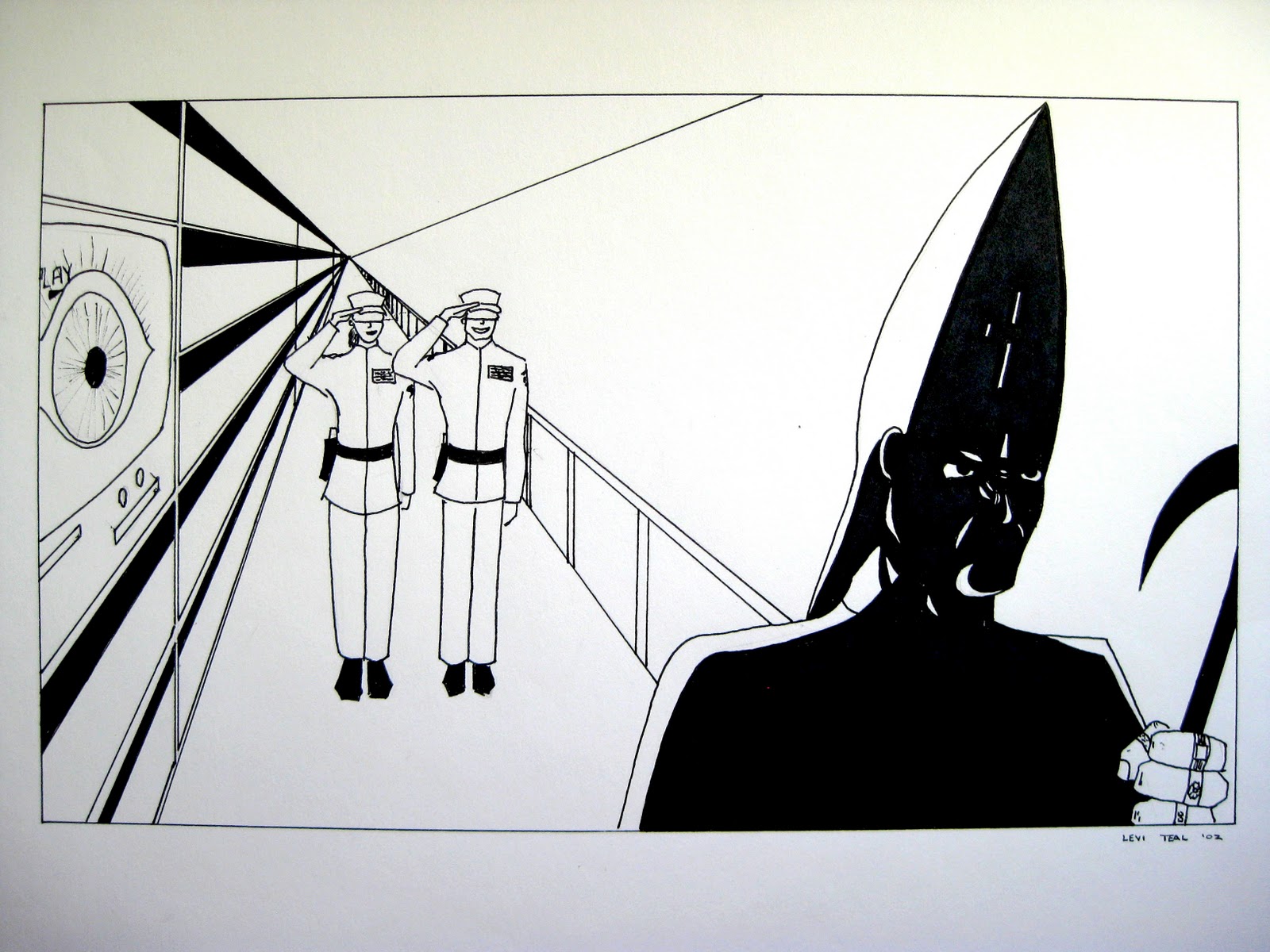
The pictures that follow came from a class I took in college, in which we were to pick a short story that we'd read in that class and adapt it for the screen, and then storyboard the script. These are my storyboards for Borges' "Library of Babel," which describes the entire universe as a vast library. Most of the books in the library are gibberish, but since the library contains every possible combination of alphabetical characters, it must also include all of the great master works. If you haven't come across this story, I recommend a trip to your own library. It can be found in either Ficciones or Labyrinths.
     In adapting it for the screen, I decided to imagine a video library instead, since the story would be told visually. The pictures weren't stored in order in my closet, and I no longer remember their order, so don't expect a narrative. Ink on tree, murdered, butchered.


19.1.11

Start Your Day with a Radioactive Donut


Ink on deceased tree, survived by two saplings. Radioactive coffee to follow.

17.1.11

Ashley's Accoutrements


Ink on dead tree. My friend Ashley's purse, hand cream, dried rose, and books. which are also ink on dead trees.

13.1.11

Camel Says Mlllahhhh!


Ink on dead tree. This particular tree died in its prime, and is survived by two saplings.